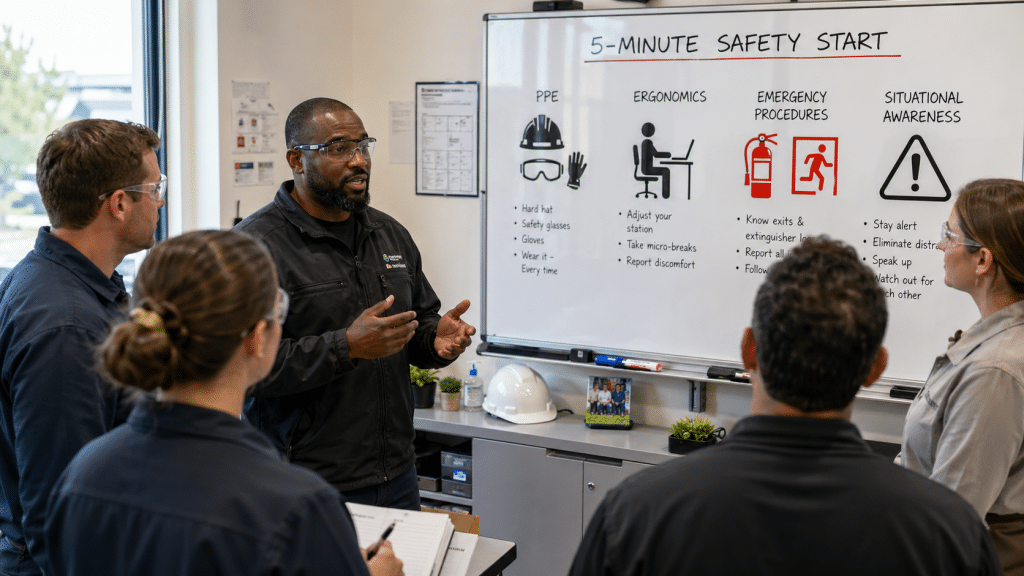
Workers get hurt not because they ignore safety, but because routine dulls awareness. In manufacturing, where machinery runs constantly and production pressures mount, a five-minute pause for a safety toolbox talk can prevent a lifetime of injury. These brief, focused discussions aren’t box-ticking exercises—they’re frontline defenses against complacency, miscommunication, and unseen hazards. The most effective talks target real, daily risks with clear, actionable takeaways. Below are the most critical and practical safety toolbox talk topics that resonate on the shop floor and deliver measurable impact.
Lockout/Tagout (LOTO): The Silent Killer’s Antidote
Machines don’t know when someone’s nearby. A conveyor restarts during maintenance. A hydraulic press cycles unexpectedly. These aren’t hypotheticals—they’re leading causes of amputations and fatalities in manufacturing.
A strong LOTO talk focuses on three areas: - Proper energy isolation: Emphasize identifying all energy sources—electrical, pneumatic, hydraulic, thermal. - Personal lock use: Each worker applies their own lock. Shared or master locks defeat the system. - Verification before work: Test-verify that the machine is truly de-energized.
Common mistake: Assuming a machine is off because it’s not running. Residual energy can still cause catastrophic movement.
Real-world example: A technician bypassed LOTO to clear a jam in a packaging line. A coworker, unaware of the maintenance, restarted the line remotely. The result: a crushed hand and a $420,000 OSHA fine.
Include a quick checklist in your talk: - Notify affected employees - Shut down equipment properly - Isolate energy sources - Apply lockout device - Release stored energy - Verify isolation
Machine Guarding: Don’t Work Around the Shield
Guards exist for one reason: to keep body parts out of danger zones. Yet, removing or bypassing guards to “speed up” a job is alarmingly common.
Toolbox talks should spotlight: - Types of machine guards (fixed, interlocked, adjustable) - Why tampering voids safety protocols - The difference between access (necessary) and exposure (deadly)
Illustrative case: At a Midwest stamping plant, operators routinely removed interlocked guards to reach inside presses during minor adjustments. After a severe finger amputation, the company mandated weekly guarding inspections and retrained all operators. Incidents dropped to zero over the next 18 months.
Highlight this takeaway: If a machine can’t perform its task with the guard in place, it’s a maintenance or design issue—not a justification for bypass.
Personal Protective Equipment (PPE): Right Gear, Right Time
PPE isn’t one-size-fits-all. A hard hat stops falling objects but does nothing against chemical splashes. A toolbox talk should clarify PPE requirements by task, not just location.
Break down PPE by hazard type: - Impact: Hard hats, safety glasses, steel-toed boots - Chemical: Gloves (nitrile, neoprene), face shields, aprons - Noise: Earplugs or muffs (rated for decibel levels) - Respiratory: N95s, half-face respirators, supplied air
Critical tip: Train workers to inspect PPE before use. A cracked face shield or torn glove offers false security.
Common failure: Wearing cut-resistant gloves near rotating machinery. If the glove catches, it can pull the hand in. For rotating equipment, snug-fitting, non-entanglement gloves may be safer.

Use a real task as an example: > Task: Deburring a metal casting with a hand grinder > Required PPE: Safety glasses and face shield, hearing protection, cut-resistant gloves (ANSI Level A3+), dust mask or respirator if ventilation is poor
Hazard Communication (HazCom): Knowing the Chemical Risks
Manufacturing uses countless chemicals—cleaners, lubricants, adhesives, coolants. Workers must know what they’re handling and what to do if something goes wrong.
An effective HazCom talk reinforces: - How to read SDS (Safety Data Sheets) - GHS pictograms and their meanings - Proper labeling of secondary containers - Spill response and first aid steps
Real incident: A maintenance worker mixed two cleaning agents in a secondary bucket, unaware they were incompatible. The reaction released chlorine gas, sending three employees to the ER.
Key message: Never assume a chemical is “safe” because it comes in a spray bottle. If it’s not water, it needs identification and handling procedures.
Include a visual aid: Show two GHS labels—one for a flammable solvent, one for a corrosive cleaner. Ask workers to identify the hazards and required controls.
Slips, Trips, and Falls: The Persistent Threat
In manufacturing, most falls aren’t from heights—they’re at ground level. Wet floors, tangled cords, cluttered walkways—they’re trip hazards waiting for a distracted second.
Focus your talk on: - Housekeeping routines (spill cleanup, tool storage) - Proper footwear (slip-resistant soles, no smooth leather) - Cable management (use cord covers, avoid across walkways)
Stat that hits home: According to the Bureau of Labor Statistics, slips, trips, and falls account for nearly 30% of all non-fatal manufacturing injuries.
Practical tip: Implement a “5S scan” at shift change—Sort, Set in order, Shine, Standardize, Sustain. Make it part of the daily handover.
Use a walkthrough example: > During morning inspection, you notice oil pooling near a CNC machine. Do you: > A) Wipe it quickly and move on > B) Place a warning cone and notify maintenance > C) Ignore it—it’s too small to matter > > Correct answer: B. Small spills grow. Document and report.
Confined Spaces: When the Walls Close In
Not all manufacturing confined spaces are obvious. Think: sump pits, silos, boilers, large tanks, or even deep trenches in maintenance bays.
A confined space talk must clarify: - What qualifies as a confined space (limited entry/exit, not designed for continuous occupancy) - Permit-required vs. non-permit spaces - Atmospheric testing protocols (O2, LEL, H2S, CO) - Rescue plans—never enter without retrieval equipment
Fatal mistake: Assuming “I’ll just pop in for 30 seconds” is safe. Asphyxiation can occur in under two minutes.
Actionable step: Post a confined space entry checklist near all high-risk zones. Include: - Permit authorization - Gas monitor readings - Attendant on duty - Communication method - Rescue gear on site
Ergonomics: The Hidden Injury Driver
Repetitive motions, awkward postures, and forceful exertions lead to musculoskeletal disorders (MSDs)—the most common manufacturing injury, often developing slowly over time.
Talk examples: - Lifting techniques: Bend knees, keep back straight, use mechanical aids - Workstation setup: Adjust height of bins, conveyors, or tools to reduce reaching and bending - Job rotation: Rotate tasks to reduce strain on specific muscle groups
Example: An assembler on a pick-and-place line developed shoulder tendinitis after six months of overhead reaching. After ergonomic adjustments—lowering the line and adding a lift assist—the pain resolved, and productivity increased 12%.
Encourage workers to report discomfort before it becomes injury. Create a culture where speaking up is expected, not discouraged.
Hot Work Permits and Fire Safety
Welding, grinding, brazing—these operations create sparks that can travel 35 feet or more. A hot work talk must stress preparation and awareness.
Cover: - Permit requirements (authorization, fire watch, extinguisher on site) - Clearance of combustibles (paper, rags, solvents, dust) - Use of fire-resistant blankets - Post-job monitoring (fire watch for at least 30 minutes after work)
Near miss: A grinder spark ignited accumulated sawdust in a corner of a fabrication shop. The fire spread quickly but was contained due to a nearby extinguisher and trained responder.
Emphasize: Hot work isn’t just about the task—it’s about the environment around it.
Electrical Safety: Respect the Current
From panel rooms to portable tools, electricity is everywhere—and often underestimated.
Key points: - Never use damaged cords or equipment - Use GFCI protection in damp areas - Avoid overloading circuits - Recognize warning signs: frayed wires, warm outlets, flickering lights
Critical reminder: Voltage kills, not amperage. Even 50 volts can be lethal under the right conditions.
Use a real scenario: > You find a dropped extension cord in a puddle. Do you: > - Pull it out by the cord? > - Turn off the breaker first? > - Let it be until the end of shift? > > Answer: Turn off the breaker. Water + electricity = electrocution risk.
Near-Miss Reporting: The Best Prevention Tool
Most serious incidents have precursors—close calls that go unreported. A strong safety culture treats near-misses as gifts: free warnings.
Your talk should: - Define what a near-miss is (e.g., a load nearly fell, a guard was left off) - Assure no retaliation for reporting - Share anonymized examples to normalize the behavior
Powerful stat: Companies with robust near-miss programs reduce recordable incidents by up to 60%.
Workflow tip: Make reporting easy—QR codes on shop floor boards that link to a simple form, or a daily verbal check-in during team huddles.
Closing: Make Every Talk Count
Toolbox talks only work if they’re relevant, frequent, and led by someone who knows the floor. Rotate facilitators. Use real incidents. Ask questions. Keep it under 10 minutes. And always end with: “What one thing will you do differently after today?”
Safety isn’t a policy—it’s a practice. Build it into every shift, every task, every conversation.
Frequently Asked Questions
What should a safety toolbox talk include? A focused topic, real-world examples, clear hazards, controls, and a call to action. Keep it under 10 minutes and encourage participation.
How often should toolbox talks happen? Weekly is ideal. Daily may be excessive unless in high-risk environments. Consistency matters more than frequency.
Who should lead toolbox talks? Supervisors, safety officers, or trained team members. Rotate to build ownership and varied perspectives.
Can toolbox talks be documented digitally? Yes. Many plants use tablets or apps to record attendance, topics, and signatures, reducing paperwork and improving tracking.
What if employees aren’t engaged? Make it interactive. Use photos, props, or real near-misses. Ask, “What would you do?” instead of lecturing.
Should toolbox talks be the same across all departments? No. Customize by area. A foundry talk differs from an assembly line or packaging zone.
How do you measure the effectiveness of toolbox talks? Track participation, near-miss reports, and incident trends. If behaviors change and close calls increase (meaning people speak up), the talks are working.
FAQ
What should you look for in Top Safety Toolbox Talk Topics for Manufacturing Teams? Focus on relevance, practical value, and how well the solution matches real user intent.
Is Top Safety Toolbox Talk Topics for Manufacturing Teams suitable for beginners? That depends on the workflow, but a clear step-by-step approach usually makes it easier to start.
How do you compare options around Top Safety Toolbox Talk Topics for Manufacturing Teams? Compare features, trust signals, limitations, pricing, and ease of implementation.
What mistakes should you avoid? Avoid generic choices, weak validation, and decisions based only on marketing claims.
What is the next best step? Shortlist the most relevant options, validate them quickly, and refine from real-world results.



:max_bytes(150000):strip_icc()/GettyImages-21696356521-4fbe8ad077b44dd89725c2f789cb6716.jpg)